

Commons:Village pump/Copyright
This Wikimedia Commons page is used for general discussions relating to copyright and license issues, and for discussions relating to specific files' copyright issues. Discussions relating to specific copyright policies should take place on the talk page of the policy, but may be advertised here. Recent sections with no replies for 7 days and sections tagged with {{section resolved|1=~~~~}} may be archived; for old discussions, see the archives.
- One of Wikimedia Commons' basic principles is: "Only free content is allowed." Please do not ask why unfree material is not allowed at Wikimedia Commons or suggest that allowing it would be a good thing.
- Have you read the FAQ?
- Any answers you receive here are not legal advice and the responder cannot be held liable for them. If you have legal questions, we can try to help but our answers cannot replace those of a qualified professional (i.e. a lawyer).
- Your question will be answered here; please check back regularly. Please do not leave your email address or other contact information, as this page is widely visible across the Internet and you are liable to receive spam.
- Please do not make deletion requests here – instead, use the relevant process for it.
 |
SpBot archives all sections tagged with {{Section resolved|1=~~~~}} after 1 day and sections whose most recent comment is older than 7 days. |
Large amounts of (potentially) pirated content being hosted on a user page??
[edit]I suspect this is a digital archive for someone, like they're using it as storage rather than other storage providers; https://commons.wikimedia.org/wiki/User:Atlasowa/New_video2commons/2025_June_1-10 This is the page i initially found, i was attempting to find all instances of a song and came across this, with multiple full episodes of The Amazing World Of Gumball just here.
User:Atlasowa/New video2commons heres the entire list, it feels like a rabbit hole.
Is this sort of thing allowed? It seems like its violating alll sorts of copyright law, but then again i see lots of videos with varying use/significance HyperNover (talk) 02:48, 30 November 2025 (UTC)
- @HyperNover apparently, for example File:The Amazing World of Gumball- Gumball & Darwin vs. The Evil Baby.webm, the underlying video is commercially licensed (by Cartoon Network India). I'm not sure if CN India has authorization from their parent firm to release the cartoon works into free culture (commercial-type) Creative Commons licensing. JWilz12345 (Talk|Contributions) 04:05, 30 November 2025 (UTC)
- One related video was deleted but later undeleted (Commons:Deletion requests/File:Tom & Jerry - Enjoy the Eternal Cat & Mouse Game of Tom & Jerry on Cartoon Network India.webm). I doubt on Cartoon Network India's legal right to commercially license their parent firm's productions, though, considering India remained among the "priority watchlist countries" in 2018. An email correspondence from Cartoon Network's parent firm may be needed to clarify if they indeed gave CN India the authorization, as well as the extent of CN India's rights to relicense the Cartoon Network productions. JWilz12345 (Talk|Contributions) 04:10, 30 November 2025 (UTC)
- It looks like the user is displaying the videos of Category:Uploaded with video2commons but in chronological order of upload. -- Asclepias (talk) 11:47, 30 November 2025 (UTC)
- Please see the discussion I started below: Commons:Village pump/Copyright#Cartoon Network India. Nosferattus (talk) 16:13, 30 November 2025 (UTC)
- With the latest information obtained by 19h00s, it is quite clear that we can't keep these videos and derivative works. So I deleted all files and closed the DR. Thanks to all for the investigation. Yann (talk) 19:05, 12 December 2025 (UTC)
- I also added Cartoon Network India channel to Commons:Questionable YouTube videos/Users. Yann (talk) 19:22, 12 December 2025 (UTC)
- Please see the discussion I started below: Commons:Village pump/Copyright#Cartoon Network India. Nosferattus (talk) 16:13, 30 November 2025 (UTC)
Cartoon Network India
[edit]All 4000+ videos posted on Cartoon Network India's YouTube channel are marked Creative Commons Attribution. These include videos of numerous cartoon franchises owned by numerous different companies (Looney Tunes, Tom & Jerry, Ben 10, The Amazing World of Gumball, Teen Titans Go, Lamput, Kiteretsu, Grizzy & the Lemmings, Batwheels, etc.). There is no way in hell that Cartoon Network India somehow overthrew capitalism and convinced some of the most litigious media companies on the planet (Warner Brothers, DC Comics) to relinquish control of their intellectual property and give away their cartoons for free in perpetuity. Please put on your thinking caps and ask if this actually makes sense. Clearly someone somewhere has made a mistake. If you think that's unlikely, notice that they also consistently misspelled the title of Grizzy & the Lemmings. Clearly this YouTube channel has low quality control and no one has noticed the incorrect license setting. We need to do two things, neither of which I know how to do:
- Nominate all the videos in Category:Videos by Cartoon Network India for deletion (in a single discussion if possible).
- Blacklist the Cartoon Network India YouTube channel from video2commons.
Can anyone help with this? Nosferattus (talk) 16:11, 30 November 2025 (UTC)
- Totally agree with you. To me, this is ridiculous on its face. This does not appear to be a purposeful choice by the actual rightsholder, but rather a designation made by an overzealous or misinformed staffer at a foreign subsidiary, which may or may not have the legal authority to license these videos as such - and that's not a legal authority I believe we should be comfortable "assuming" they had. We need some kind of proof that this was purposeful and authorized by the rightsholder, unlike with individuals, where it's generally safe to assume that any person has the legal authority to release their own work. However, it does appear that all the shows Cartoon Network India has uploaded are in fact owned by Cartoon Network or their parent company, Warner Bros Discovery, some via other subsidiaries (for example: Grizzy & the Lemmings was produced in part by the French TV channel Boomerang, which is owned by WBD; Batwheels is property of DC Comics, which is owned by WBD; and the rights to Tom & Jerry were purchased from Hanna-Barbera by Turner Broadcasting in 1986, which merged with TimeWarner in 1996 and eventually became WBD). 19h00s (talk) 18:30, 30 November 2025 (UTC)
- Warner Brothers Discovery's Clip and Still Licensing guidelines and contact info may be of relevance here. JWilz12345 (Talk|Contributions) 22:21, 30 November 2025 (UTC)
- I took my own initiative and just sent correspondence to clipandstilldept@wbd.com, in hopes of getting a response from at least one department from WBD. Fingers crossed, though. JWilz12345 (Talk|Contributions) 22:35, 30 November 2025 (UTC)
- @JWilz12345: Did you hear anything back? A faster approach might be to repost one of the videos on YouTube and see how long it takes to get it taken down with a copyright strike. My guess is less than a day. Nosferattus (talk) 06:42, 3 December 2025 (UTC)
- @Nosferattus no response from the Clips and Stills Department of Warner Bros Discovery, so far. I don't have an account on YT (and I don't have any plan to create one in the forseeable future). JWilz12345 (Talk|Contributions) 06:50, 3 December 2025 (UTC)
- @19h00s and JWilz12345: Since we didn't hear back from Warner Bros (I also emailed them a few days ago), I went ahead and created a deletion discussion: Commons:Deletion requests/Category:Videos by Cartoon Network India. Unfortunately, I don't know how to properly nominate all 68 files without doing it manually. Does someone know how to do that? Nosferattus (talk) 20:57, 3 December 2025 (UTC)
- I'm not sure we're gonna hear back from WBD anytime soon given the news (the company is splitting its Discovery properties into a new entity and selling its Warner Bros/HBO properties to Netflix, pending regulatory approval). I imagine there's about to be a lot of work for the licensing team as they split up their content and possibly assign new IP ownership. 19h00s (talk) 16:34, 5 December 2025 (UTC)
- @19h00s and JWilz12345: Since we didn't hear back from Warner Bros (I also emailed them a few days ago), I went ahead and created a deletion discussion: Commons:Deletion requests/Category:Videos by Cartoon Network India. Unfortunately, I don't know how to properly nominate all 68 files without doing it manually. Does someone know how to do that? Nosferattus (talk) 20:57, 3 December 2025 (UTC)
- @Nosferattus no response from the Clips and Stills Department of Warner Bros Discovery, so far. I don't have an account on YT (and I don't have any plan to create one in the forseeable future). JWilz12345 (Talk|Contributions) 06:50, 3 December 2025 (UTC)
- @JWilz12345: Did you hear anything back? A faster approach might be to repost one of the videos on YouTube and see how long it takes to get it taken down with a copyright strike. My guess is less than a day. Nosferattus (talk) 06:42, 3 December 2025 (UTC)
- Can you think of any plausible scenario in which a staffer would mark all their videos as CC BY SA without intending to do exactly that? Trade (talk) 01:43, 8 December 2025 (UTC)
.svg/20px-Pictogram_voting_comment_(orange).svg.png) Comment It is indeed surprising that these videos are under a free license. They should be contacted to make sure the license is valid, on YT or on https://www.facebook.com/CartoonNetwork.India/. Another possibility is to write to copyright@youtube.com (I did that). But if we don't get any answer, I don't see any reason to delete these files from Commons. There is no doubt that this is an official channel, so we do not have to make a double standard with free licenses. Yann (talk) 15:31, 4 December 2025 (UTC)
Comment It is indeed surprising that these videos are under a free license. They should be contacted to make sure the license is valid, on YT or on https://www.facebook.com/CartoonNetwork.India/. Another possibility is to write to copyright@youtube.com (I did that). But if we don't get any answer, I don't see any reason to delete these files from Commons. There is no doubt that this is an official channel, so we do not have to make a double standard with free licenses. Yann (talk) 15:31, 4 December 2025 (UTC)
- Hi, I got an answer from YouTube which basically says: If you are the copyright holder, then send a takedown notice (with the form). It is clear that YouTube doesn't care. Yann (talk) 17:19, 5 December 2025 (UTC)
- Perhaps we should take the same attitude here, though unlike them I think we would do well to add a warning template about questioning the authority of Cartoon Network India to release these. Or we could just delete. But nothing else between seems to make much sense to me. - Jmabel ! talk 20:32, 5 December 2025 (UTC)
- If it's under CC law and Warner India released it under then it should be creative commons, so i think we should keep the files.
- Also similar situation with NickRewind releasing character depictions and videos under CC, people might take advantage of this for fanworks or some weird stuff.
- Also sorry for pinging @Yann Is anything okay btw? Idk why i'm asking this sorry lol ZigZagTheTigerSkunk (talk) 19:08, 7 December 2025 (UTC)
- I dont see what fan works could possibly be done with a bunch of TV clip compilations Trade (talk) 01:48, 8 December 2025 (UTC)
- Idk, maybe memes and crap like that. ZigZagTheTigerSkunk (talk) 02:27, 8 December 2025 (UTC)
- I dont see what fan works could possibly be done with a bunch of TV clip compilations Trade (talk) 01:48, 8 December 2025 (UTC)
- Sounds like the thing you propose is the exact thing task already being fulfilled by {{Free depiction (Cartoon Network)}} and {{Official Cartoon Network India YouTube channel}}
- Or am i wrong? Trade (talk) 01:47, 8 December 2025 (UTC)
- Perhaps we should take the same attitude here, though unlike them I think we would do well to add a warning template about questioning the authority of Cartoon Network India to release these. Or we could just delete. But nothing else between seems to make much sense to me. - Jmabel ! talk 20:32, 5 December 2025 (UTC)
- Hi, I got an answer from YouTube which basically says: If you are the copyright holder, then send a takedown notice (with the form). It is clear that YouTube doesn't care. Yann (talk) 17:19, 5 December 2025 (UTC)
- DR the category. Unlikely that CNI has the authority to freely license the works. The guy uploading files to YouTube would not have relicensing in his scope of employment. Glrx (talk) 04:04, 8 December 2025 (UTC)
- Cartoon Network India is offically owned by Warner. ZigZagTheTigerSkunk (talk) 13:11, 8 December 2025 (UTC)
- So is WBTV which asserts that the clips are fully copyrighted.[1] Nosferattus (talk) 17:38, 8 December 2025 (UTC)
- Hmm.. Seems a bit more complicated than i thought. ZigZagTheTigerSkunk (talk) 17:58, 8 December 2025 (UTC)
- So is WBTV which asserts that the clips are fully copyrighted.[1] Nosferattus (talk) 17:38, 8 December 2025 (UTC)
- I agree with this due to the sheer volume of materials 'licensed' here. Though, this does make me wonder about Hasbro Australia. Sure, it's much, much less than CNI, but should we also put into question whether or not the Australia subsidiary got proper permission from the main company to freely license these materials too? Cawfeecrow (talk) 03:03, 19 December 2025 (UTC)
- @Cawfeecrow: I would recommend someone initiate a deletion discussion for the matter. – Howardcorn33 (💬) 19:42, 23 December 2025 (UTC)
- Cartoon Network India is offically owned by Warner. ZigZagTheTigerSkunk (talk) 13:11, 8 December 2025 (UTC)
Images contained in court decisions (EU)
[edit]I know court decisions are part of the public domain. But my question is if images contained in court decisions can be uploaded? ANd if so, what kind of images are permissible? For example, a logo of a private company used in a document of a court decision (in a trade mark case). Maat777 (talk) 10:21, 21 December 2025 (UTC)
- No, courts do not acquire copyright in exhibits. A private company logo included in a judgment is usually still copyrighted and cannot be uploaded to Commons unless it is clearly below the threshold of originality or released under a free license. --Jonatan Svensson Glad (talk) 13:17, 21 December 2025 (UTC)
- Are you sure that court decisions are public domain? I'm not finding any license tag for that in Category:PD European Union license tags. And which court exactly do you mean? The EU court? Or a court of one of the EU member states? Nakonana (talk) 13:52, 21 December 2025 (UTC)
- If we're talking about the EU court then it doesn't sound like the documents are PD according to this website[2] as there are too many restrictions:
Any citizen of the Union, and any natural or legal person residing or having its registered office in a Member State, has a right of access to documents of the institutions, bodies, offices and agencies of the Union, whatever their medium.
— Access granted only to people from the European Union, not to people outside the EU. And it only grants "access", not that one can share and change the documents as one pleases or use them for commercial purposes.The Court of Justice adopted a decision setting out how it deals with access to documents requests relating to its administrative work only. There is no right of public access to documents it holds relating to its ‘judicial work’, which includes pleadings, evidence and its internal deliberations on cases. The legal basis for this exception to the general rule of public access to documents is found in paragraph 4 of Article 15(3) of the Treaty on the Functioning of the EU (TFEU), which states that the right of public access to documents does not apply to the Court of Justice, except when it is exercising its ‘administrative tasks’.
— Access granted only to administrative tasks, not to judicial work. And again, it only grants "access", nothing else. I'd say that court decisions are judicial work, not administrative tasks.
- Nakonana (talk) 14:09, 21 December 2025 (UTC)
- These notices have nothing to do with copyright, but only with the right to receive copies upon request.
- For instance, you will find in German copyright law that official acts of government are excused from copyright (Article 5 of the German copyright statute). The same exceptions are found in virtually every country. In the US, this is the "edicts of government" exception to copyright. In pretty much every country, this excludes all court decisions, domestic and foreign, from copyright. D. Benjamin Miller (talk) 18:57, 21 December 2025 (UTC)
- Because most EU member states include an exception in their national legislation that acts of government (like court decisions) are not copyrightable, I thought that those texts were in the public domain. Just like Bejamin Miller said for the German statute or article XI.172 in the belgian economic code. But I do not know if those exceptions include materials included in those decisions or not. Maat777 (talk) 08:20, 22 December 2025 (UTC)
- The actual decisions are always public domain, but external copyrighted works that might be incorporated into them remain copyrighted. D. Benjamin Miller (talk) 10:00, 22 December 2025 (UTC)
- If we're talking about the EU court then it doesn't sound like the documents are PD according to this website[2] as there are too many restrictions:
- Comment I don't know if these are free of copyright, but if they are, they should be uploaded as PDF files, not images. Yann (talk) 15:43, 21 December 2025 (UTC)
- They are only allowed on Commons if there is no restrictions on re-use, which becomes sort of a quasi public domain license. That does not appear to be the case here. -Nard (Hablemonos) (Let's talk) 16:13, 21 December 2025 (UTC)
- The laws in the EU member state countries can differ from the rules that apply to the EU Court of Justice. But tbh, even then I'd rather question whether court decisions are public domain in EU countries per se (because they can contain very private information if not redacted). {{PD-GermanGov}}, for example, says they are, but a court ruling determined[3] that this is only true if the court decision is actually published by the court itself (
Amtlich verfaßt seien Leitsätze nur dann, wenn das veröffentlichende Gericht in Erfüllung seines hoheitlichen Amtes den Leitsatz verfasse und veröffentliche.
) (in the given case, a judge was providing such guidelines to a publisher on a private contractual agreement, which means that they were not published by the court itself and thus not "official"). But judging by some other website[4] it seems that not all court decisions are published but only if they are deemed useful for the legal discourse and public (and also per the Federal Court of Germany[5]:daß allen Gerichten […] kraft Bundesverfassungsrechts die Aufgabe obliegt, die Entscheidungen ihrer Spruchkörper der Öffentlichkeit zugänglich zu machen. Insoweit handelt es sich bei der Veröffentlichung von Gerichtsentscheidungen um eine öffentliche Aufgabe. Sie erfaßt alle Entscheidungen, an deren Veröffentlichung die Öffentlichkeit ein Interesse hat oder haben kann.
). Unless I'm reading that wrong. The German wiki article w:de:Publikation von Gerichtsentscheidungen also states that most court decisions remain unpublished. So, even if a citizen would request and be granted access to the court decision of a particular court case, I'm not sure whether they could just upload it to Commons if it's an unpublished court decision. Nakonana (talk) 18:58, 21 December 2025 (UTC)- Personal data privacy laws have nothing to do with copyright. German law, as with the laws in other EU countries and almost every country in general, excludes court decisions from copyright. D. Benjamin Miller (talk) 18:59, 21 December 2025 (UTC)
- The laws in the EU member state countries can differ from the rules that apply to the EU Court of Justice. But tbh, even then I'd rather question whether court decisions are public domain in EU countries per se (because they can contain very private information if not redacted). {{PD-GermanGov}}, for example, says they are, but a court ruling determined[3] that this is only true if the court decision is actually published by the court itself (
- They are only allowed on Commons if there is no restrictions on re-use, which becomes sort of a quasi public domain license. That does not appear to be the case here. -Nard (Hablemonos) (Let's talk) 16:13, 21 December 2025 (UTC)
Shouldn't this file be deemed as a derivative of w:en:File:NobelPrize1.jpg which is non-free in its country of origin, Sweden? Jonteemil (talk) 01:36, 22 December 2025 (UTC)
- Yes, most likely so as it appears to be a derivative of the Lindberg design. – Howardcorn33 (💬) 12:07, 22 December 2025 (UTC)
Is this template valid? Apparently used to tag images of works of art from Taiwan in which their designers or artists "waived" their rights to claim copyright if the photos of their works are commercially used (?). No image uses this template as of this writing. See recent changes at COM:FOP Taiwan. JWilz12345 (Talk|Contributions) 02:10, 22 December 2025 (UTC)
- At the very least, this should be renamed as {{Copyrighted free use-Taiwan-art}}, on the same pattern as {{Copyrighted free use}}. Technically this is not a Freedom of Panorama exemption, since FoP is only a legal privilege given by law. The waiver from the artists constitutes the precepts of the CopyrightedFreeUse template, not the FoP law of Taiwan (no disclaimer provided under Article 58). Ping @Teetrition: (who was one of the involved users in Taiwanese FoP discussions). JWilz12345 (Talk|Contributions) 02:17, 22 December 2025 (UTC)
- I agree with you. I've noted the changes at COM:FOP Taiwan, and it seems doubtful that any artists would actually use this disclaimer. Teetrition (talk) 02:53, 23 December 2025 (UTC)
- @Teetrition I may boldly move the template title by myself, to {{Copyrighted free use-Taiwan-art}}, if no one opposes. "BUMPING" this again to prevent bot archiving. JWilz12345 (Talk|Contributions) 04:14, 28 December 2025 (UTC)
- I agree with you. I've noted the changes at COM:FOP Taiwan, and it seems doubtful that any artists would actually use this disclaimer. Teetrition (talk) 02:53, 23 December 2025 (UTC)
Milad tower PD next year(?)
[edit]Per Commons:Deletion requests/File:Milad Tower from Goftogu Park 2.jpg, the architectural copyright expires next year (50+1 years after creation). Yet w:en:Milad Tower mentions the name of the architect. Which is true in accordance with COM:Iran: CREATE+50+1 or AUTHOR DEATH YEAR+50+1? JWilz12345 (Talk|Contributions) 04:02, 22 December 2025 (UTC)
- Milad Tower was not finished in 1975, so that date is not really relevant to anything. If a legal entity owns the rights on the building it will expire 30 years from publication. Also copyright does not run to the end of the year in Iran REAL 💬 ⬆ 16:22, 22 December 2025 (UTC)
- Pinging @Jeff G. on how come the year 1975 was comcluded in the discussions. JWilz12345 (Talk|Contributions) 23:24, 22 December 2025 (UTC)

Oldest works in copyright in the EU
[edit]| SPARQL code |
|---|
SELECT ?work ?workLabel ?pubDate ?author ?authorLabel ?deathDate WHERE {
  {
    SELECT ?author (MIN(?pubDate) AS ?minPub) WHERE {
      ?author wdt:P31 wd:Q5;
              wdt:P570 ?deathDate;
              wdt:P569 ?birthDate.

      # Still in copyright today (life+70 as of 2025-12-21)
      FILTER(?deathDate >= "1956-01-01T00:00:00Z"^^xsd:dateTime)

      # Make 19th-c publications plausible
      FILTER(?birthDate <= "1875-01-01T00:00:00Z"^^xsd:dateTime)

      ?work wdt:P50 ?author;
            wdt:P577 ?pubDate.

      # ---- ADD THESE LINES ----
      BIND(YEAR(?pubDate) AS ?py)
      BIND(YEAR(?birthDate) AS ?by)
      BIND(YEAR(?deathDate) AS ?dy)
      FILTER(?dy <= ?by + 115)
      FILTER(?py >= ?by + 12)
      # -------------------------
    }
    GROUP BY ?author
    ORDER BY ASC(?minPub)
    LIMIT 200
  }

  # Now retrieve a representative work at that author's earliest pub date
  ?work wdt:P50 ?author;
        wdt:P577 ?pubDate.
  FILTER(?pubDate = ?minPub)

  ?author wdt:P570 ?deathDate.

  SERVICE wikibase:label { bd:serviceParam wikibase:language "en". }
}
ORDER BY ASC(?pubDate)
LIMIT 50
|
I wasted some time today using Wikidata Query Service to produce a list of the oldest works still in copyright in life+70 nations. The answer is
- s:en:The Royal Family of France (Henry) (1882) by s:en:Author:Lucien Edward Henry (died 1957), or
- All Among the Barley: A Novel (1882) by Flora Hayter (died 1959) (Wikidata only).--Prosfilaes (talk) 06:00, 22 December 2025 (UTC)
Question RE: Data in copyrighted works
[edit]I am not knowledgable at all about copyright law, so forgive me if this is a frivolous question, but would uploading a visual depiction that I have created, of purely numerical data that I have found in a work protected by copyright be permitted? (Naturally the original source would be cited in the descripton.) Idkpineapples (talk) 07:59, 22 December 2025 (UTC)
- @Idkpineapples: Purely numerical data is factual information and contains no original authorship, and so should be filed under {{PD-ineligible}}. – Howardcorn33 (💬) 10:36, 22 December 2025 (UTC)
- If you created the visual depiction of the data yourself, then it would be permitted. – Howardcorn33 (💬) 10:39, 22 December 2025 (UTC)
What does 50 years after publication mean?
[edit]To my knowledge, in Indonesia, photographic works issued by legal entities (in my case a record label) are subjected to copyright until after 50 years of its publication. Please correct me on this. 2026 is a few weeks away, and I have some 1976 album covers from a singer that I would really like to upload. As soon as the new year hits, will the album cover become public domain? Or will I have to wait until the precise date during which the album was released? What if I do not know the exact date? Thank you in advance. Sorry if this has been asked before. WannzKaswan (talk) 14:08, 22 December 2025 (UTC)
- Sources from Indonesian Commons claims that a work's copyright will expire 50 years after its original publication, but only becomes public domain the year after? Is this true? That means I might have to wait until 2027... WannzKaswan (talk) 14:19, 22 December 2025 (UTC)
- I don't specifically know about Indonesia, but most countries go by year, not day within the year, so if your analysis is correct, you have to wait one more year.
- "Issued" is not a term that usually arises in copyright law. If the term translates to "created" rather than "published", a relevant copyright-holder may be an artist, photographer, or even graphic designer (or some combination of these) rather than the record label, and they may have rights based on their lifetime, not year of publication. Again, I say this with no specific knowledge of the laws of that particular country. - Jmabel ! talk 19:21, 22 December 2025 (UTC)
iNaturalist tools acting up
[edit]This image is causing troubles. First I was unable to transfer it using inat2wiki.toolforge; it detects the license as cc-by-nc. This is frustrating because the copyright holder changed it to cc-by-sa on my request and the page clearly says cc-by-sa. iNaturalist Import tool also failed to detect it among suitable images. I uploaded it hoping to bypass iNaturalist tools and get a human review, but it still got flagged for speedy deletion by INaturalistReviewBot. The file is at File:Cyprinodon dearborni shoal.jpg. Surtsicna (talk) 22:41, 22 December 2025 (UTC)
- @Surtsicna: are you still in contact with Mr Boccia? The "front" page of https://inaturalist.lu/observations/254901139 doesn't state CC-by-SA 4.0, but CC-By 4.0. - Furthermore, the detail page https://inaturalist.lu/photos/456683744 still has the NC license, that's why the bot is likely assuming the unsuitability for Commons. Regards, Grand-Duc (talk) 23:24, 22 December 2025 (UTC)
- Yes, only the photo license matters, not the license for the observation data. AntiCompositeNumber (they/them) (talk) 02:22, 23 December 2025 (UTC)
- This is such a facepalm moment. I sent the observation data page link when I asked for the license change and it never occurred to me that the observation and photo licenses might not be connected. Thank you both for explaining and thanks for helping out, Grand-Duc. Surtsicna (talk) 10:25, 23 December 2025 (UTC)
- Yes, only the photo license matters, not the license for the observation data. AntiCompositeNumber (they/them) (talk) 02:22, 23 December 2025 (UTC)
US Passport photos
[edit]On the page for Category:United States passport photos there is a section about the copyright of passport photos. It raises the possibility that passport photos may not be eligible for copyright because they do not meet the threshold of originality. That seems to rely only on a statement found on this page. It is not at all clear that the statement was made in relation to US passports.
I believe that passport photos meet the deliberately low bar for originality despite the guidelines that photographers must follow. Regardless of my opinion, we should clearly be following the precautionary principle here. If we are not certain that US passport photos are ineligible for copyright, we should not have them here.
I don't believe that the discussion of copyright on the category page is normal or helpful. Any such statements belong in guidelines or help pages. I have read the recent discussions on this noticeboard and I learned nothing. Is there any settled case law about this? Is the entire "below the threshold of originality" just some editor's wishful thinking or is there a documented basis for it? Counterfeit Purses (talk) 05:20, 23 December 2025 (UTC)
- My only problem with accepting passport photos is we reject other photos that are below TOO, There was a New York case that ruled thay clip art such as photos of food on a menu were below TOO but good luck gettinh Commons to accept them. -Nard (Hablemonos) (Let's talk) 12:42, 23 December 2025 (UTC)
- @Nard the Bard I would be surprised by that ruling. What is the name of the case? Counterfeit Purses (talk) 16:41, 23 December 2025 (UTC)
- Oriental Art Printing, Inc. v. Goldstar Printing Corp.; one of the photographs denied protection by that case is found on page 1522 of this Brooklyn Law Review article. prospectprospekt (talk) 17:55, 23 December 2025 (UTC) edited 18:02, 23 December 2025 (UTC)
- @Nard the Bard I would be surprised by that ruling. What is the name of the case? Counterfeit Purses (talk) 16:41, 23 December 2025 (UTC)
- Per the US State Dept.'s website, it is clear that individuals outside the US govt may create and submit their own passport photos according to particular guidelines, so we cannot rely on arguments utilizing {{PD-USGov-DOS}}.
- (Disclosure: I am not a lawyer, I am an amateur only attempting to make sense of what I have read.)
- The only relevant case I can find with such routine portrait photography is the California case Dlugolecki v. Poppel, which dealt with unauthorized usage of yearbook photos of Meghan Markle in news broadcasts.
- In its summary of the same preliminary finding, the US Copyright Office said "On [...] the nature of the copyrighted work, the court declined to “make any fine distinctions between creative and factual works,” accepting that there was a minimal measure of creativity in the photographs that slightly benefited Dlugolecki."
- According to a 2025 article by law professor Paul Szynol, "A mug shot and passport photos are paradigm examples of an image produced in strict compliance with preexisting dictates that, by definition, not only don’t require creativity, but actively prohibit it. [...] Generic portraits—like high-school yearbook photos—are no more creative than mug shots." I am not sure if Dlugolecki v. Poppel went beyond a preliminary finding, or if its ongoing, but if it did ultimately conclude that such photographs were not protected by copyright, that would most likely mean that passport photos wouldn't be either.
- Since I am not a lawyer, I therefore have to ask these questions:
- Is Dlugolecki v. Poppel ongoing? Did the case conclude beyond anything other than a preliminary finding?
- If so, would its verdict about the yearbook photos say anything about the copyrightability of passport photos?
- If not, is its preliminary finding enough for "significant doubt" about such photos' copyrightability that COM:PCP will require us to delete passport photos?
- – Howardcorn33 (💬) 13:09, 23 December 2025 (UTC)
- @Howardcorn33 I think you may have misinterpreted the statement in Dlugolecki v. Poppel. They were merely stating that despite the nature of the images, they met the standard for creativity. It wasn't in doubt. That statement is just checking off an item on the checklist.
- Szynol isn't saying that passport photos and mugshots are ineligible for copyright. He is saying that they shouldn't be, which is very different. Right after the sentence that you quote, he says
The formulae listed above would nevertheless provide courts with a doctrinal basis for finding creativity
and lists the reasons. He is saying that mugshots and passports photos are, in the current interpretation of the law, copyrighted. Counterfeit Purses (talk) 16:39, 23 December 2025 (UTC)- @Counterfeit Purses: thanks for clarifying. So should we take Szynol's statement about the current interpretation of the law (rather than his own advice) to mean that such photos are indeed copyrighted and therefore we should not permit them on Commons? – Howardcorn33 (💬) 19:35, 23 December 2025 (UTC)
- (Or at the very least that such photos have such significant doubt regarding their copyright status that COM:PCP applies?) – Howardcorn33 (💬) 19:36, 23 December 2025 (UTC)
- @Howardcorn33 That's how I take it but I'm just another editor like you and not an expert in these matters. Counterfeit Purses (talk) 22:27, 23 December 2025 (UTC)
- Has there ever actually been a case in the United States of anyone successfully registering copyright of a mugshot photo? Do we have any legal precedent here? PARAKANYAA (talk) 06:06, 26 December 2025 (UTC)
- @Counterfeit Purses: thanks for clarifying. So should we take Szynol's statement about the current interpretation of the law (rather than his own advice) to mean that such photos are indeed copyrighted and therefore we should not permit them on Commons? – Howardcorn33 (💬) 19:35, 23 December 2025 (UTC)
- Szynol isn't saying that passport photos and mugshots are ineligible for copyright. He is saying that they shouldn't be, which is very different. Right after the sentence that you quote, he says
- For me, almost any photo of a 3D object has enough creativity to merit a copyright. Even if I'm wrong, the issue is close enough to raise COM:PCP.
- The arguments for mugshot and passport photos usually play in another sandbox.
- The mugshot question is usually about whether photographs taken by government employees have a copyright. That question varies by jurisdiction. Criminals do not supply their own mugshots.
- Passport photos are not taken by government employees. Is my passport photo a work for hire where I own the copyright or does the photographer still hold the copyright? There usually is not a written contract where the copyright is transferred to me. A similar situation is when a passerby snaps a photo of me using my camera. Ramanujan's passport photo is a complicated mess: an unknown Indian photographer took the photo, but Chandrasekhar's heir claims she got the rights from Ramanujan's heir.
- Back to creativity. I like my current driver's license photo. I was told to stand on the mark; that does not require much creativity. The DMV employee then gave me two posing instructions — instructions not needed for the ID photo. For me, those instructions take the picture out of the carnival photo booth realm. Even without those instructions, a yearbook or passport photographer gets to set up the lighting, and that involves more than mechanically clicking a shutter release. Maybe the same spacing and lighting is used for hundreds of passport photos, but that does not mean no creativity was involved. A Kodak pamphlet goes into a lot of detail about setting up lighting for a portrait.
- The Copyright Office has also registered CCTV footage, so there is a presumption that even some utilitarian imaging can have a copyright. There are utilitarian images that are outside of copyright. For example, my recent series of x-rays are medical images that fall outside of copyright.
- Glrx (talk) 19:41, 23 December 2025 (UTC)
- Passport photos aren't typically works for hire in the legal sense, that requires an employee employer relationship. They fall under the legal category of commissioned works, where the photographer almost always retains copyright (LifeTouch sends me emails every year reminding me they have photos of my kid from every year of his life, should I choose to purchase). Unlike yearbook photos, however passport photo companies rarely retain originals once the transaction is done, which is a pretty clear sign of implied transfer of copyright (destroying all copies of a work is considered a sign of copyright abandonment per Pacific and Southern Co., Inc. v. Duncan) but again, good luck convincing Commons. -Nard (Hablemonos) (Let's talk) 20:30, 23 December 2025 (UTC)
- The ground on which we deny copyright protection to X-Ray images is ridiculously flimsy, there has not once been a legal case on the matter. It is at least as originated by an human author as any passport photo or mugshot. The human author frames it, puts the subject into position, sets everything about how the image is going to look. If you think any photo of a 3D object passes the threshold of originality (which I don't agree with), I don't know why you would defend our practice of declaring those free based off of 0 legal precedent. PARAKANYAA (talk) 06:00, 26 December 2025 (UTC)
- m:Wikilegal/Copyright of Medical Imaging Glrx (talk) 18:30, 26 December 2025 (UTC)
- Yes, and that isn't legal precedent, and by your own admission here the exact same thing backing the medical imaging is free idea has been ignored previously. The case is just as flimsy as that of passport photos. PARAKANYAA (talk) 05:48, 27 December 2025 (UTC)
- The US federal government body in charge of registering copyrights has declared that medical imaging is not eligible for copyright. That's the first line of the linked page. That's not flimsy; the first any US plaintiff is going to have to do is tell the judge that they applied to register their copyright but were denied one on the grounds that they did not have a valid copyright, according to the US copyright office. Then the defendant is going to provide the judge with the letter of final judgement where the Copyright Office explains that. That's pretty solid in my opinion.--Prosfilaes (talk) 07:24, 27 December 2025 (UTC)
- Yes, and that isn't legal precedent, and by your own admission here the exact same thing backing the medical imaging is free idea has been ignored previously. The case is just as flimsy as that of passport photos. PARAKANYAA (talk) 05:48, 27 December 2025 (UTC)
- m:Wikilegal/Copyright of Medical Imaging Glrx (talk) 18:30, 26 December 2025 (UTC)
@Bremps @D. Benjamin Miller @Clindberg @Jeff G. You all participated in a similar discussion here in March 2024. Any thoughts? Counterfeit Purses (talk) 22:47, 23 December 2025 (UTC)
- Can we add a subsection "Passport photos" in Commons:Copyright_rules_by_territory/United_States#Miscellaneous addressing this? Perhaps something along the lines of:
ID photos in US passports may not be assumed public domain works of the federal government as private citizens may submit their own photos. The copyrightability of such photos which adhere to strict compositional standards is unclear, but are presumed to have such significant doubt as to be deleted under the precautionary principle. Passport photos known to be shot by employees of US embassies and consulates as part of their official duties may be tagged with {{PD-USGov-DoS}}.
- The fact that the government specifies a size and a plain background does not limit the creativity of the actual photographer. Most formal portraits are made to a specified size with a background chosen by the subject. Therefore, if you argue that a passport photographer is not entitled to a copyright, you must argue that no formal portrait deserves one. . Jim . . . (Jameslwoodward) (talk to me) 11:47, 27 December 2025 (UTC)
- The fact of being a passport photo doesn't really change the copyrightability requirements one way or another. Given that they do prescribe a straight-on photo and the basic cropping, does mean there is not a lot of room left for creativity. The angle and framing are generally two of the more copyrightable aspects of a photo. But, you can use your own photo for passports, and not sure what would make those uncopyrightable. It's possible that something like that could be ruled below the threshold depending on the circumstances, but we haven't had a ruling to that effect, or a statement like that from the Copyright Office. So, I would tend to avoid claiming PD status on them inherently. There is more creativity possible than say X-rays or other medical imaging, which do have such a statement, meaning we are on much safer ground there. Carl Lindberg (talk) 20:32, 27 December 2025 (UTC)
TOO of Swiss signatures
[edit]Are signatures of non-artistic nature (i.e. not a painter's work) like en:File:John Gnaegy signature.png or en:File:Beat Jans signature.png above or below TOO in Switzerland? And is there a difference between signatures of living people and those of people who are no longer alive?
(This is a followup to en:WP:Media copyright questions#Swiss signatures.) YuniToumei (talk) 15:54, 23 December 2025 (UTC)
- @YuniToumei: Per COM:TOO Switzerland,
Swiss copyright law defines works as "literary and artistic intellectual creations with individual character, irrespective of their value or purpose".
If we take this at face value, a signature, being a written mark intended to be unique to an individual, would appear to be literary, a creation, and have individual character and would therefore suffice for copyright. – Howardcorn33 (💬) 20:00, 23 December 2025 (UTC)- Thanks, @Howardcorn33! That makes sense to me and means that the cases of all the signatures of people who are alive or died recently are clear to me.
- Follow-up question regarding Gnaegy's signature: en:John Gnaegy died in 1772 which should place his works firmly within PD. However, the file is currently under free use and attributes the copyright to en:Ralph Beaver Strassburger who died in 1959. Under Swiss law, his works are copyrighted until 1959+70=2029. The signature appears in his book as a "facsimile", which the book describes as tracings and photographies of the original signatures. Am I understanding correctly that this would not generate new copyright attributed to Strassburger, and that this depiction of Gnaegy's signature would thus be PD? YuniToumei (talk) 22:39, 23 December 2025 (UTC)
- @YuniToumei: Facsimilies would most likely be covered under {{PD-scan}}. – Howardcorn33 (💬) 23:07, 23 December 2025 (UTC)
- Nonsense. A signature is not a "literary" work, because the Swiss copyright law's definition of category (a) says that these are "linguistic works," and a name is not such a work. You would have to argue that the letter is somehow a "graphic work." Furthermore, the Swiss courts have consistently held that there is a very high standard for "individual character." Many photographs were considered by Swiss law not to have "individual character," despite being copyrightable in the United States (which has a fairly high TOO). Only recently was Swiss law amended to specifically protect photographs of 3D objects even if they lack individual character; the requirement remains in place for all other types of works. It is virtually inconceivable that any ordinary signature could be copyrightable under Swiss law. @Howardcorn33 @YuniToumei D. Benjamin Miller (talk) 04:33, 24 December 2025 (UTC)
- Thank you! In that case, I will retag the relevant files and move them to commons soon :) YuniToumei (talk) 00:04, 26 December 2025 (UTC)
- @D. Benjamin Miller Could we get this info on COM:TOO Switzerland at some point? No rush or obligation, of course, but it'd be nice to have an easy-to-access reference point for this kind of thing. Cawfeecrow (talk) 11:24, 26 December 2025 (UTC)
Copyright query: New Zealand geology - an illustrated guide
[edit]I seek clarification about interpreting the statement on page 2 of the published work: New Zealand geology - an illustrated guide. The statement on page 2 says: "This eBook is free to everyone. It is free of copyright restrictions, with the exception of the NIWA chart in Chapter 1 and various photographs supplied by GNS Science, as stated in the captions." Does this mean that I can take snips of illustrations (other than the exceptions listed) and upload these into Wikimedia Commons as "Public domain" or similar ? This is a great resource, and I would be keen to upload some of the illustrations if permissible._Marshelec (talk) 07:22, 24 December 2025 (UTC)
- @Marshelec: The intention is pretty clear, even if their vocabulary to talk about copyright is poor (you can't wish copyright away, you can just give people permission to ignore it). I would say that anything in the book (with the stated exceptions) could be uploaded as {{Copyrighted free use}}. - Jmabel ! talk 20:19, 24 December 2025 (UTC)
- Thanks, that's great. :)_Marshelec (talk) 20:46, 24 December 2025 (UTC)
Screenshot of painting on YT
[edit]In a recent YT video from Baumgartner Restoration, a portrait of Frances Hodgson Burnett painted by Dora Wheeler Keith (d. 1940) was discovered. Can we legally grab a screenshot of the painting from the video? ~2025-42754-69 (talk) 12:06, 24 December 2025 (UTC)
- Yes, if you crop to just the painting, and note the frame or background. Andy Mabbett (Pigsonthewing); Talk to Andy; Andy's edits 14:28, 24 December 2025 (UTC)
- @~2025-42754-69: I assume you refer to this video? Since Keith was American, US law applies, which means publication is relevant. Thankfully the video provides us with all the relevant information, beginning at 47:49:
- Painting was created in 1884 by Keith
- Painting was privately held after its creation
- It was entirely unpublished until the airing of the video (Dec. 2025)
- Therefore {{PD-US-unpublished}} should apply. – Howardcorn33 (💬) 14:48, 24 December 2025 (UTC)
{{ping|Howardcorn33]] {{PD-US-unpublished}} - Jmabel ! talk 20:22, 24 December 2025 (UTC)I must have somehow missed that his ended his post with the license. - Jmabel ! talk 21:22, 24 December 2025 (UTC)
- Thanks guys ~2025-42754-69 (talk) 21:13, 24 December 2025 (UTC)
Pink Cube
[edit]Would this image of a pink cube be considered ineligible for copyright as a simple, non-artistic depiction of a geometric form? If so, what is the correct copyright information template to use when uploading the image? -- Cl3phact0 (talk) 16:43, 24 December 2025 (UTC)
- I don't think the cube itself is copyrighted, but the photograph of the cube can be. Please see Commons:When to use the PD-Art tag#This does not apply to photographs of 3D works of art. Thanks. Tvpuppy (talk) 16:56, 24 December 2025 (UTC)
- Thank you. Given that the framing, lighting, and point of view of image don't seem to demonstrate originality (it's a neutral, isometric, evenly lit image of a pink cube), I'm not sure how to interpret the rule in this case. -- Cl3phact0 (talk) 17:09, 24 December 2025 (UTC)
- With a three-dimensional object, even "neutrality" is a decision. Yes, the photo is probably copyrighted. - Jmabel ! talk 20:23, 24 December 2025 (UTC)
- That sounds like "no, we can't use this". As we have loads of cubes (and even rather a lot of c:Category:Cubes in art), it seemed like there might be a shot with this one. Worth a roll of the dice? -- Cl3phact0 (talk) 22:16, 24 December 2025 (UTC)
- With a three-dimensional object, even "neutrality" is a decision. Yes, the photo is probably copyrighted. - Jmabel ! talk 20:23, 24 December 2025 (UTC)
- Thank you. Given that the framing, lighting, and point of view of image don't seem to demonstrate originality (it's a neutral, isometric, evenly lit image of a pink cube), I'm not sure how to interpret the rule in this case. -- Cl3phact0 (talk) 17:09, 24 December 2025 (UTC)
This file is heavily in use so I thought I'd bring it here instead of going directly to a DR. Is the eagle cut-out to the left really below COM:TOO Germany? Jonteemil (talk) 23:30, 24 December 2025 (UTC)
- Probably yes, Germany still has a rather high TOO even after the court cases several years ago. I'm not so sure about COM:TOO US here though. --Rosenzweig τ 16:43, 26 December 2025 (UTC)
hCaptcha CAPTCHA UI
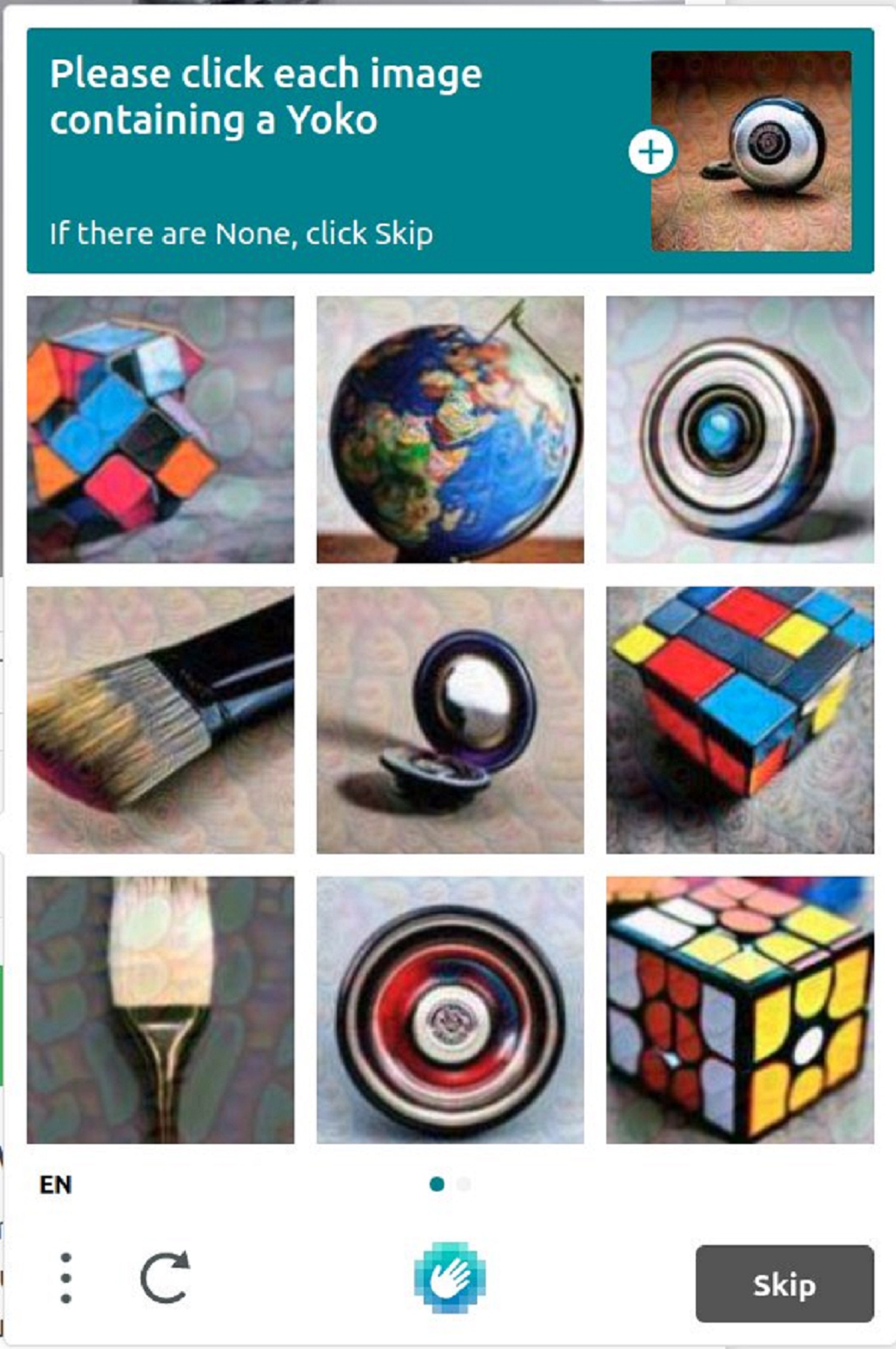
[edit]Is the hCaptcha CAPTCHA interface copyrightable? I'm asking as I'm planning to replace the wonderfully outdated image on enwiki's CAPTCHA article with this 2023 image of hCaptcha taken from this Vice article. I chose this image in particular as it is very obvious that the images are AI-generated (see the linked Vice article) and therefore in the public domain; I'm just not sure if the UI itself is copyrighted or not (obviously the logo is copyrighted and would need to be masked out). Thank you. OutsideNormality (talk) 05:17, 25 December 2025 (UTC)
- If we can be confident that all the images there are AI-generated, then I see nothing else there that would be copyrightable in the U.S. - Jmabel ! talk 19:23, 25 December 2025 (UTC)
SVG renderings of proprietary fonts/typefaces
[edit]I am aware that raster renderings of any font made in the US are generally under the public domain. What is not clear to me is the copyright status of vector (SVG) renderings of proprietary font made in the US. {{PD-font}} lays out one of the following caveats:
Vector format images of fonts (such as SVG) may be copyrighted in the United States.
If "vector format images of fonts" means vector representations of any font, and "may be copyrighted" refers to the copyright status of an individual font (free or proprietary) that is determined on a case-by-case basis, almost all SVG entries in Category:Typeface samples and its subcategories (e.g., Category:Typeface samples (Font Specimen Creator)) would be at risk of deletion for copyright violations. Most of the fonts/typefaces present in the said categories are proprietary, with notable examples being Arial, Comic Sans, Futura, and Helvetica.
One might argue that the term "font" refers to the software that allows a computer to render a typeface, such as TrueType (TTF) and OpenType (OTF) files. Font file formats are not supported file formats.
I managed to find several deletion requests on the subject matter. Only one deletion request, as far as I found, resulted in the successful deletion of what I presumed to be a few vector typeface samples.
Note that I am basing this discussion on US copyright laws and how they apply to fonts/typefaces.
Here are the relevant questions:
- Would vector representations of proprietary fonts on Wikimedia Commons, including vector-based typeface samples, be subject to deletion due to copyright (e.g., Microsoft YaHei.svg)?
- Does Wikimedia Commons make a distinction between the terms "font" and "typeface", especially in copyright policies? Are users, especially nominators of deletion discussions I mentioned, aware of the said distinction?
AlphaBeta135talk 05:52, 25 December 2025 (UTC)
- Re. #1: in most cases, no. Under US law, typefaces are not protected by copyright; this extends to any representation of the typeface, whether it's in print, a bitmap image, or vector graphics. Font files may in some cases be copyrightable, but, as you noted, this is a moot point because they cannot be uploaded to Commons. The language in Commons:Licensing#Fonts which specifies "raster renderings" should be removed, as it has no legal basis. Omphalographer (talk) 21:02, 25 December 2025 (UTC)
- The actual computer code is what might be copyrighted. The uploader would have had to independently create the svg, which probably explains why raster versions never have a concern. It's not a legal distinction, its a practical one. -Nard (Hablemonos) (Let's talk) 04:28, 26 December 2025 (UTC)
- It was a legal distinction, actually. Vector fonts have been protected as computer software (there is more information in those than just the font outlines, like kerning etc.), but not bitmap. Additionally, the choice of vector points by itself has been ruled copyrightable in a vectorization of a PD image (land maps). In general, I think trying to use copyright loopholes to copy fonts will fall down once you get back to a vector format. Typeface is the shape of the letters, and that aspect is not technically copyrightable in the U.S. (though can be in France and the UK and maybe other places). Fonts typically mean the computer files that make them usable; those are protected in the U.S. as software, and the vector points can be separately copyrightable. In general, usages of fonts are probably OK (we wouldn't delete a graphic because it made use of a commercial font), but copies of the typeface itself, particularly vector, are almost certainly a copyright issue even in the U.S. Carl Lindberg (talk) 20:41, 27 December 2025 (UTC)
- Is it the computer code that is present in TTF or OTF files? AlphaBeta135talk 16:42, 26 December 2025 (UTC)
- The actual computer code is what might be copyrighted. The uploader would have had to independently create the svg, which probably explains why raster versions never have a concern. It's not a legal distinction, its a practical one. -Nard (Hablemonos) (Let's talk) 04:28, 26 December 2025 (UTC)
President.ge
[edit]Since 30 December 2024, the website of the President of Georgia was under construction, and re-opened later but without the CC license statement. The CC license was last noted on 29 December 2024, therefore uploads before that date is still OK as CC license are non-revokable. A1Cafel (talk) 14:06, 25 December 2025 (UTC)
1937 UK photograph
[edit]
This photograph was published in The Tatler, a London magazine, on 10 February 1937. It was attributed to "Bassano", and the original is held by the National Portrait Gallery. Could someone please advise on its copyright status, and whether it would be appropriate for Commons? To the extent publication in the US need be shown, the magazine gives publication information at the bottom of the 70th page, where it states that it is printed and published in England, and "Entered as Second-class Matter at the New York (N.Y.) Post Office, 1903." The cover also indicates different postage rates for "Inland", Canada and Newfoundland", and "Foreign", the latter of which would apply to the US. Thanks in advance for any help. --Usernameunique (talk) 02:35, 26 December 2025 (UTC)
- Alexander Bassano retired in 1903 and sold his business, which retained his name. He died in 1913. Assuming the Bassano credit is for the firm, and not a person, you could use {{PD-UK-Unknown}} to tag this. If the magazine had subscribers in the US, you could use {{PD-URAA-simul}} unless the US copyright was properly registered and renewed, which sounds doubtful. -Nard (Hablemonos) (Let's talk) 02:47, 26 December 2025 (UTC)
- Thanks, Nard the Bard. Per Penn's database of periodical renewals, The Tatler does not appear to have renewed any of their issues in the US (if they even copyrighted them in the first place). --Usernameunique (talk) 03:27, 26 December 2025 (UTC)
- I've now uploaded the photo (seen here). Thanks again! --Usernameunique (talk) 17:58, 26 December 2025 (UTC)
- Thanks, Nard the Bard. Per Penn's database of periodical renewals, The Tatler does not appear to have renewed any of their issues in the US (if they even copyrighted them in the first place). --Usernameunique (talk) 03:27, 26 December 2025 (UTC)
Unclear licencing statements (review)
[edit]These pics are from the same ext. source

.jpg)
![[1]](https://commons.wikimedia.org/wiki/File:Looney_Tunes_YouTube_Copyright_Claim.png)



Currently on our project, these are marked "PDM" (unreviewed) If one clicks on "License: PublicDomain" these statements come up:
- CC0 1.0 Public Domain Universal
- CERTIFICATION 1.0 US Public Domain United States
- PDM 1.0 Public Domain Universal
while nothing is checkmarked or highlighted. There is no note "pick one". Only one of the three licenses is given in the pics in our project. Is "PDM" only correct? Seasonal greetings, --Mateus2019 (talk) 11:33, 26 December 2025 (UTC)
- It's not a PDM. The link to CC doesn't really help. The file might perhaps have been tagged simply PD-author, if it weren't for the statement of copyright. The line "© [name] [...] PublicDomain" doesn't make much sense. It's also unclear if one part of that line might have been placed by the author and another part by the website. The whole thing is confused. The general statement of the photographer [6] doesn't help either where he says "Please do not redistribute my images in part or whole, for money or for free. You need my specific permission for that. Please read the terms of use and image licence." You'll have to decide if think that you can tell with certainty what the real status is. -- Asclepias (talk) 13:03, 26 December 2025 (UTC)
Deletion requests
[edit]Please see Commons:Deletion requests/File:Initiative ‘Children without tobacco’, 2022.jpg.

Thanks in advance. Graisely-1818 (talk) 11:42, 26 December 2025 (UTC).
- @Graisely-1818: Hello, The page of the DR closed in October 2025 was not really the place to start that discussion today. Undeletion requests can be made on the page Commons:Undeletion requests. You can also discuss here. I'm taking the liberty to move your comment here, below. -- Asclepias (talk) 13:19, 26 December 2025 (UTC)
- Hello. I see that one of my picture has been deleted (although the subject has Wikipedia articles). The second one, also a political poster, has not.

- In my understanding, Wikimedia Commons and Wikipedia publish many political posters from street pictures as encyclopaedic information.
- Many are found in Switzerland (Category:Political signage in Switzerland) and around the globe (Category:Political signage by country).
- Can we restore this picture? Graisely-1818 (talk) 11:39, 26 December 2025 (UTC).
- The file was deleted for reasons of copyright, not for reasons of project scope. Please see Commons:Derivative works. It can't be restored on Commons unless the poster is freely licensed or in the public domain. The categories should include only free licensed or public domain works, but copyright violations might be found there if they have not been spotted and deleted. -- Asclepias (talk) 15:47, 26 December 2025 (UTC)
- Some posters are too simple to be copyrighted.
- Some posters may have been photographed "in the wild" in countries where there is Freedom of Panorama for 2-dimensional works.
- Some posters may be from countries/periods where there were necessary formalities to gain a copyright (e.g. the U.S. before March 1989). - Jmabel ! talk 18:12, 26 December 2025 (UTC)
- @Graisely-1818 "as encyclopaedic information" is simply not enough. For media files to be hosted here, these must also be freely reusable by anyone for any purpose (see COM:Licensing). For use on Wikipedia or for educational use only are not enough. JWilz12345 (Talk|Contributions) 00:40, 27 December 2025 (UTC)
- Can we restore this picture? Graisely-1818 (talk) 11:39, 26 December 2025 (UTC).
PD-Art vs PD-Scan
[edit]Stupid question which I already asked over on Technical because I'm not sure if this is a copyright issue or a technical issue. PD-art says "a faithful photographic reproduction" whereas PD-scan says "a mere mechanical scan or photocopy". When it isn't clear whether the digitisation was done via photo or scan, which tag should be used? The Edinburgh Early Photography Archive (talk) 01:05, 27 December 2025 (UTC)
- In my mind both tags are superfluous, you can use them to tag something you downloaded from a website to indicate you didn't take the picture yourself, but I can't think of a situation where a file lacking the tag is in serious danger of deletion. But, to answer your question, it is unlikely that art hanging in a gallery has been scanned, and is probably photographed. A postcard or a print might have gone through either process. So PD-Art is for art hanging in a gallery, or perhaps a book, and PD-scan is for prints. -Nard (Hablemonos) (Let's talk) 13:57, 27 December 2025 (UTC)
Can this be considered Public Domain
[edit]Hi,
I wanted to ask if this work can be considered Public Domain? I'm interested in a snippet of the title page for the book's article on the English Wikipedia, The Natives Of Mailu.
The book was first published in 1915, but this uploaded work was republished in 1988. The original author Bronisław Malinowski died in 1942. You can read the article for clearer details. Kingsacrificer (talk) 16:13, 28 December 2025 (UTC)
- Text that you are able to demonstrate was originally published in the 1915 edition (or any later edition prior to 1930) will be public domain and you can use it without concern. Any text that has been adapted for the 1988 edition (such as modifications by the named editor) will be in copyright in London for the editor's life plus 70 years. The copyright page indicates simultaneous publication in New York in 1988 but includes a copyright notice for the editor; my limited understanding of Commons:Copyright rules by territory/United States is that this was sufficient to establish copyright in the US at the time of publication (though I am happy to be corrected by a more experienced user) - though again this would only apply to text modified for the 1988 edition. From Hill To Shore (talk) 16:34, 28 December 2025 (UTC)
- Considering what kingsacrificer wants is the a 'snippet' of the title page of the book, I think threshold of originality should be considered too
- @Kingsacrificer, when you say "
...a snippet of the title page
" do you mean the top bit of what is page six in the edition you linked? Considering it would simply be the title of the book + the author, it might be too unoriginal to be eligible for copyright in the UK and US. The UK has a bit of a lower bar (or 'threshold') for originality which includes typographical copyrights*, but considering that the font doesn't look modified, It's probably fine. I'm not a lawyer and I haven't spent as much time staring at info about UK copyright law as I have for info about US copyright law, so take this with a grain of salt. - For more information, See COM:TOO UK
- *I would like to note that typographical copyright apparently does not include the simple use of a typeface as I initially thought! According to the Copyright, Designs and Patents Act 1988:
- "
It is not an infringement of copyright in an artistic work consisting of the design of a typeface— (a)to use the typeface in the ordinary course of typing, composing text, typesetting or printing, (b)to possess an article for the purpose of such use, or (c)to do anything in relation to material produced by such use
" - I add this because I initially was going to add a statement about how the typeface's copyright wouldn't be a concern as it'd be old enough for it to have expired (typographical copyright only lasts 25 years after publication), but it seems that it doesn't even need to be considered in the first place as artistic use of a typeface is not a part of typographical copyright. Again, grain of salt. Cawfeecrow (talk) 18:40, 28 December 2025 (UTC)
- @Cawfeecrow @From Hill To Shore
- Thank you for responding.
- My aim is to add the entire title page to the book's enwiki article. I cannot find anything useful pertaining to the original edition of 1915.
- The fact that the editor's name will not appear in the original edition's title page, but appears in the 1988 editions' title page (yes, page 6) could also be over the copyright TOO, couldn't it? Kingsacrificer (talk) 19:08, 28 December 2025 (UTC)
- I wouldn't think so as it's just more authorial information (translator's name + academic titles) and a location, but TOO is finnicky sometimes and I'm not too familiar with where UK draws the line. Very inclined to say that the full page would be below TOO. For clarification, under TOO is good, above TOO is a copyright violation.
- I would like to mention that (as this generally concerns an enwiki page), you can always use a free use rationale if you're still weary about it. The only thing would be is that it would be uploaded locally to enwiki and not into Commons. Cawfeecrow (talk) 20:06, 28 December 2025 (UTC)
- I can't use the fair use rationale in this case because there is always A POSSIBILITY that the 1915 edition appears from somewhere and is available for use under PD. Kingsacrificer (talk) 22:00, 28 December 2025 (UTC)
- @Kingsacrificer: Even though the cover page of the republished version was originally uploaded locally to English Wikipedia as non-free content, it's really too simple to be eligible for copyright protection under US copyright law and most likely under British copyirght law too given the new COM:TOO UK. So, I've converted the local file's licensing to "PD-simple" and re-added the file to the article. In my opinion, the file is OK for Commons but if others feel differently, it still seems too simple under US copyright law and can be treated as public domain for local use on English Wikipedia. -- Marchjuly (talk) 05:49, 29 December 2025 (UTC)
- I can't use the fair use rationale in this case because there is always A POSSIBILITY that the 1915 edition appears from somewhere and is available for use under PD. Kingsacrificer (talk) 22:00, 28 December 2025 (UTC)
A image got deleted despite consent from the author
[edit]Hi, — Preceding unsigned comment added by Stefangrotz (talk • contribs) 22:07, 28 December 2025 (UTC)
In june the file File:Esperanto-Klubo-Amundsen-Scott-2022.jpg got deleted after a very short discussion. It is a picture of the first Esperanto-Club in Antarctica. (first published on instagram: https://www.instagram.com/p/CdfZmkQuTjS/)

The owner of the picture assured me, that he followed the ownership process as it was described on the template that appeared on the file page. A week later or so the picture got deleted without any communication.
Since I still believe that this picture is already under a creative commons license and there shouldn't be any issues, I uploaded it again: File:Esperanto-klubo-amundsen-scott-2022.jpg But this time I would like to do things right.

What are the next steps to keep it online? Stefangrotz (talk) 21:54, 28 December 2025 (UTC)
- @Stefangrotz Please see COM:VRT. As the image was published first on another website, the photographer had to either add the appropriate licence at the source website or submit suitable evidence through the VRT process. The deletion of the previous image was due to the lack of that required evidence. I can't see evidence of the required licence at the source page, so I will mark your upload as lacking permission - this will give you a week to start the VRT process (please add the Template:Permission pending to the page after submitting the VRT email). Please note that as you have reuploaded a previously deleted file, an administrator has the right to delete the file immediately without waiting the normal 7 days for permission. If the file is deleted before the VRT process is completed, please do not reupload the same file. Instead, provide the name/link to the deleted file in the email sent to VRT. The VRT will restore the deleted image if the evidence is acceptable. From Hill To Shore (talk) 22:49, 28 December 2025 (UTC)
- Thanks for the reply. Can you please check the email for the old file name Esperanto-Klubo-Amundsen-Scott-2022.jpg? Stefangrotz (talk) 22:52, 28 December 2025 (UTC)
- @Stefangrotz Sorry, I don't have permission to access the VRT process, so I can't provide an answer. I'd recommend asking again at Commons:Volunteer Response Team/Noticeboard as that is the place to verify cases that are in progress. From Hill To Shore (talk) 22:57, 28 December 2025 (UTC)
- Thanks for the reply. Can you please check the email for the old file name Esperanto-Klubo-Amundsen-Scott-2022.jpg? Stefangrotz (talk) 22:52, 28 December 2025 (UTC)